Isherwood Williams
Earth AbidesIsherwood Williams, called Ish, is a solitary geographer whose survival after The Great Disaster turns him from an observer of human and natural systems into an influential, if often uneasy, participant in the remaking of society. His life traces a difficult passage from isolation to responsibility: he helps The Tribe endure, yet cannot ensure that it will inherit the knowledge or ambitions he believes it needs. In old age, his standing as the last American and a tribal oracle makes him a symbol of the past even as he recognizes that his authority has outgrown his understanding.
Identity and Survival
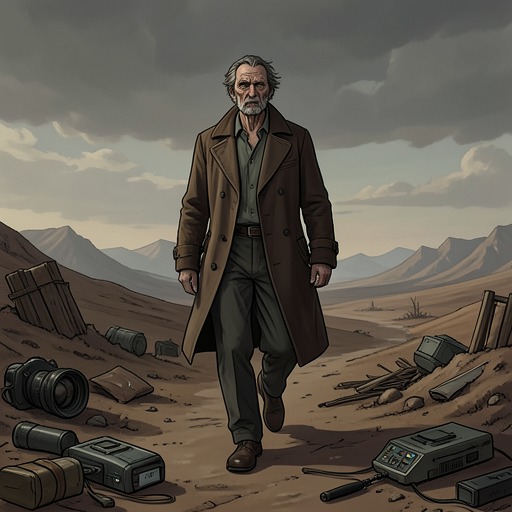
Before the disaster, Ish was a graduate student investigating the relationships between people, plants, and animals in the Black Creek Area. His thesis concerned the ecology of the region, and fieldwork regularly took him alone into the mountains. He did not regard this as reckless: he liked solitude, disliked the practical trouble of keeping a dog, and saw no reason to postpone research until a suitable companion appeared. His professional habits and private temperament thus pointed in the same direction, toward careful observation conducted at a distance from other people.
The isolation that had seemed ordinary becomes more consequential when Ish falls ill in his cabin. As his condition worsens, he writes a note to leave a record of events, signing only Ish because using his full name, Isherwood Williams, takes too much effort and his nickname is what people know. The detail captures how thoroughly his everyday identity has narrowed to a familiar name. Cars pass without stopping, and he is too weak to make himself heard; the people who might once have made his solitude feel chosen are no longer dependable presences.
When he wakes with the bite reduced to local soreness and his head clear, Ish considers whether a new disease and the snake venom may have counteracted one another. He treats this as the simplest explanation for his survival, not as established knowledge. His interpretation of the surrounding signs is more decisive: people who fled from the sight of a sick man were likely fugitives afraid of contagion; the car heard on the road may have carried more refugees; and the collie’s excitement had pointed toward trouble at the power-house. A private illness has become his first way of assembling the evidence of a much wider catastrophe.
Solitude and Contact
Ish’s solitary disposition persists after survival becomes possible. When he sees smoke that may indicate people nearby, he considers investigating, then hesitates. Earlier attempts to make contact have brought little satisfaction, and his old shyness returns. He compares the prospect of rescue with the possibility of remaining on his own island, admitting to himself that he may fear human entanglements as much as he wants company. He calls Princess and drives in the opposite direction. The choice is not simply a failure to recognize other people’s importance; it shows how a habit that helped him live alone can also obstruct the beginnings of community.
His meeting with Em marks a different kind of contact. They discover that they have been using the same name, Princess, for the dog without knowing one another’s names. Ish explains that Isherwood was his mother’s maiden name and that everyone called him Ish; Em introduces herself as Emma, usually Em. Their shared laughter gives the meeting an ease Ish has not found in his encounters with strangers. Yet the episode also exposes his uncertainty about intimacy: he recognizes that companionship between a man and a woman asks more of him than simply sharing food, and that the self-reliance which carried him through isolation now works against closeness. The relationship becomes a lasting part of his life; years later, he describes himself as having lived with Em for twenty-two years.
From Observer to Organizer
Ish names his will to live plainly: he wants to see what happens to a world without human beings, and how it happens. He identifies himself as a geographer and also notes that he has always been solitary. The pairing joins curiosity to distance. At first, the changed world is something he can study, but the condition of the surviving community gradually makes detached observation harder to sustain.
During a gathering at his home, amid general satisfaction with the prospects for the coming year, Ish feels renewed dissatisfaction. He is troubled by the community’s reliance on supplies left behind by the Old Times and by the possibility that those stores will eventually run out. He rises and argues that The Tribe cannot continue scavenging indefinitely without learning to produce what it needs. His examples make the danger concrete: even ordinary fires will become harder to manage when matches are used up or spoiled. What begins as concern about supplies is also a question of inheritance—what future generations will be able to do when the remnants of the previous society fail.
By this stage, society’s adjustment and reconstruction have become Ish’s chief intellectual concern. He understands that his position differs from that of scholars who can observe and comment without being responsible for their own community. The Tribe is small, but its members turn to him when difficulties arise, and he expects that a serious emergency would bring him into a leadership role. He has read about scholars who became rulers, including Marcus Aurelius, Thomas More, and Woodrow Wilson, and takes little comfort from their histories. Ish does not claim to be a ruler; he sees himself as the community’s thinker, with unusual influence over the shape of its future. That influence brings obligation without giving him confidence that he can direct events successfully.
Memory, Failure, and Inheritance
The distance between Ish’s former identity and his later life becomes tangible when he returns to a library and finds a familiar book in the geography section. A month before The Great Disaster, Isherwood Williams had borrowed the volume. Ish recognizes the name only after a pause: no one has called him by his full name for many years. The book reconnects the old graduate student to the man who survived, but it does not restore the old world. He knows the volume has been superseded and has no practical value for human progress, yet he returns it reverently to its shelf rather than destroying it. His gesture registers attachment to knowledge even when its former uses have disappeared.
That attachment is not the same as confidence in his own success. After trying to plan for the community’s future, Ish admits that what he has attempted has failed, while also recognizing that he will never entirely stop trying. The admission revises neither his concern nor his temperament; it changes the scale of his ambition. Instead of expecting a comprehensive solution, he allows that trying for less may ultimately achieve more. His persistent worry is both a burden and a form of care: it keeps the future in view when other people can accept the present’s relative comfort.
Ezra later gives Ish a communal account of what each survivor contributed. George’s carpentry, Ish’s foresight, and Ezra’s ability to help people work together all mattered, but Ezra places Em’s courage above them. Ish’s own importance is therefore neither denied nor made absolute. The community needed his ability to anticipate problems, but survival depended on different kinds of competence and on the courage that sustained people through danger. This recognition answers, in part, Ish’s recurring question about the value of his efforts: his work belongs to a collective history, not to a solitary achievement.
Old Age and Meaning
In old age, Ish’s intellectual authority becomes a source of dependence. Young men ask him questions, sometimes about matters he does not know, such as where to find good hunting. When they are displeased by his inability to answer, they pinch him until he gives directions anyway. On a clear-minded day, he realizes that he has become a god, or at least an oracle through whom a god is thought to speak. He remembers that the children once feared carrying his hammer and accepted his claim to be an American with knowing nods. He never wanted divine status; it has grown from the community’s beliefs and its need to place authority somewhere.
After Ezra’s absence becomes clear, Ish grips the hammer, now too heavy for him to lift with one hand. He thinks of it as the symbol of a tribal god, though its weight also makes his own frailty unmistakable. During the autumn fires, Jack is the person who chiefly cares for him, under a decision Ish understands The Tribe has made. He weighs the conflicting names attached to him—god, divine mouthpiece, last American—and rejects the first two as literal descriptions. What he accepts is more modest: the care given to him and the comfort of still being the last American. His identity is by then partly his own memory and partly the story the younger generation tells about him.
Near the end, Ish looks toward the hills and measures his life against what he believes he has accomplished. He imagines that the young men will commit him to the earth, while recognizing that he too commits them to it: human generations pass, but the earth remains. The thought brings his life back to the natural world he once studied as a graduate student. He began as a man who went alone into the mountains to observe the relations among people, plants, and animals; he ends with no claim that civilization can be preserved by one observer or one leader. His enduring significance lies instead in the questions he kept asking, the foresight he offered The Tribe, and the care that allowed others to continue after him.